Showing posts with label Christopher Nolan. Show all posts

Sunday, 16 June 2013

Why the World Doesn't Need Zach Snyder: Man of Steel Review


In 2006, Bryan Singer's Superman Returns was released in cinemas. Halfway between a franchise reboot and sequel to Richards Donner and Lester's Superman: The Movie and Superman II, Returns garnered largely positive reviews yet failed to find popularity amongst audiences, and fared poorly at the box office. A sequel was said to be in the works, and if the law of superhero sequels, exemplified by X-Men 2, Spiderman 2, and The Dark Knight holds any water, Singer's sequel could have been something special. Sadly, Superman Returns' failure at the box-office ultimately led to its follow up being axed. One rumoured title for that film was Man of Steel: now, seven years on, a new film directed by Zach Snyder, unconnected to both Superman Returns and its predecessors, but bearing that title, is released. And, oh, won't it make you yearn for what could have been, as 2013's Man of Steel is not only one of the most bloated, muddled and boring superhero films in recent memory, but also one of the worst films of the year. Yes, Zach Snyder has once again demonstrated that character, dialogue and tension are secondary concerns in favour of empty spectacle, dreary cinematography and obnoxious stylisation.

Coming from the director of the risible Sucker Punch, it comes as little surprise that Man of Steel fails to match the verisimilitude and the emotional nuance of either Richard Donner and Bryan Singer's iterations of the character. However, what disappoints the most is the broken promise of the excellent marketing campaign. Man of Steel's trailers were suggestive of a reflective, toned-down character piece: an examination of what it means to be a man of steel, a companion, if you will, to Christopher Nolan's analysis of Batman in The Dark Knight. Snyder's title invites comparisons to Nolan's film, and indeed, much of the reticence over Snyder's hiring as director was assuaged by Nolan's dual role as producer and story supervisor. Because of this, Man of Steel's abject failure as a weighty, grown-up comic adaptation is felt all the more acutely.
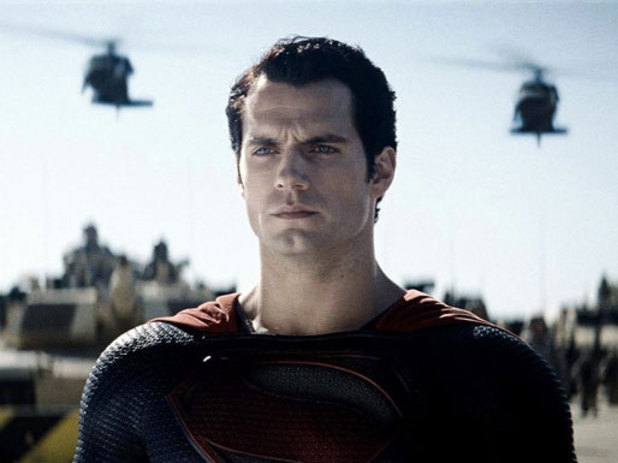
Steel-jawed: Cavill is undoubtedly the right fit for Kal-El.
Snyder's heavy stylisation of his films, his insistent use of slow motion, over-use of pop music, washed-out colour schemes and odd (to be generous) sense of framing are often laid out as his failings as a director. With the exceptions of slow-motion and pop music, Man of Steel finds all of these idiosyncrasies present and correct. However, Snyder's fundamental inadequacy as a storyteller does not come from his overwrought style, but rather, his complete lack of a sense of character depth and narrative pacing. Let me give an example: the first act of Man of Steel broadly mirrors that of the 1978 Superman: The Movie - the Kryptonian General Zod attempts to lead a military coup and is imprisoned in the Phantom Zone; Jor-El sends his infant son, Kal, to Earth to survive Krypton's imminent destruction. Kal, raised as Clark Kent, grows up, struggling to come to terms with his emerging powers in a world that will not accept them. Clark travels to the Arctic to discover his Fortress of Solitude where he learns about Krypton. Clark puts on the suit, becomes Superman, and hey presto, journeys back to civilisation to save the world. The difference between the 1978 and 2013 versions of this story is that one is invested with depth, clarity and wonderful moments of characterisation, and the other shows Superman crashing into a mountain. Let's focus on the sequence where Clark finally puts on the suit. This is one of the most important moments in the story, the turning point where Clark finally accepts his destiny, reconciling his dual identities of Clark Kent and Kal-El into that of Superman. In the Donner version, we travel north with Clark, discover the Fortress of Solitude, and witness him learn about his Kryptonian heritage. In a sequence that lasts no more than a few minutes, we feel the years that Clark spends in the fortress, learning about Krypton and coming to terms with his identity. Spending almost a decade alone, Clark grows from a boy into a man, and when he finally emerges, clothed in the suit that he has carried with him his entire life, he stands in the distance, barely visible, motionless. The famous John Williams score begins, and, almost imperceptibly, Superman lifts off the ground. He flies towards the camera, swoops off frame to the right, and in a mere second is gone. It's our first glimpse of what is to come. It's tense, controlled and thrilling: the perfect mixture of character and narrative development. In the 2013 version, through almost sheer coincidence Clark travels to the Arctic and meets Jor-El as a hologram, who shows him the suit rotating in a glass box. Jor-El tells him he has to be a symbol of hope (or something), and in the very next scene, with zero sense of time passing (does Clark put on the suit immediately, or some time after?), Clark emerges wearing the suit. Illuminated from behind, Clark walks slowly as his cape billows majestically in the arctic wind. In many ways it is a beautiful shot, but for the fact that it is completely lacking in any tension or sense of payoff. Even though both sequences last roughly the same amount of time, and both appear at roughly the same point in their respective films, Snyder's version comes of as hollow, anticlimactic and devoid of purpose. The suit reveal at this point, and in this way, tells us nothing of the character, or the reasons why Clark has so readily accepted the mantle of Superman. The audience reaction should be of exhilaration, eliciting a sense of catharsis, but here, at best, it is closer to leaning over to the person next to you and whispering, 'oooh, that looks cool'.

That mentality, of 'it's good because it looks cool', is at the heart of everything that is wrong with Man of Steel, and more broadly, Snyder's approach as a director. As Mark Kermode rightly pointed out in his review of Watchmen, Snyder is clearly in thrall with the source material, approaching Superman with reverence and passion. He understands that when Superman dons the suit it must feel momentous, and that when he meets Lois Lane it must lead to romance. But he fundamentally does not understand why Superman wears the suit, or why he and Lois can and do fall in love. For all Man of Steel's navel-gazing ponderous tone, Snyder is incapable of exploring the reasons behind character motivation or narrative theme. This works when you are making a visceral exploitation film like his remake of Dawn of the Dead, but it does not work here, especially when the film constantly tells us how important this story is. Superman is arguably the most iconic character in Western pop culture, and indeed, Snyder recognises that iconography, but he categorically does not understand it. He sees Superman's 'S', but he cannot see the man behind it.
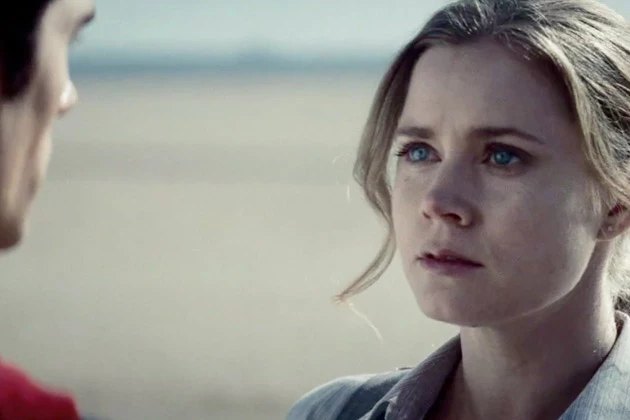
One of Adams' few scenes with Cavill.
Richard Donner knew that his Superman had to feel relatable: heroic yes, but also flawed: when Superman reverses time and saves Lois, he does so at the expense of his promise not to interfere with Earth's history, as well as being motivated by his past failure to save his father's life. Bryan Singer, too, knew that drama is more than smashing into buildings and melting things with heat-vision: his Superman suffered the consequences of leaving Lois behind for 6 years to get on with her life without him. Singer and Donner are directors that understand that the essentials of storytelling - drama, tension, character - come from internal conflict, and that action, however spectacular, is merely the external manifestation of that conflict. Zach Snyder simply does not understand this, seeing only the surface and mistaking that for the story. His response to a scene not working on an emotional level is to drain the colour, turn up the bass and crudely zoom in the camera, as if to force us to look harder for that elusive drama. You can look as hard as you like: in Snyder's cinema there are images but no imagery; things happen but there is no story. The result of this profound shallowness is that in this vision of Superman, every box that we expect to be ticked is done so blankly and without interrogation - the suit, Jonathan Kent, Jor-El, Lois, the Daily Planet are all here - but none of them have the slightest depth or meaning beyond the audience cooing over their presence on the screen.

This lack of depth could (maybe) be forgiven if, as with last year's marvelous Avengers, Man of Steel contained any sense of levity, humour or fun. Even the brooding Dark Knight trilogy had moments of all three, ably offered by supporting characters Alfred and Lucius Fox. Man of Steel, however, has none of this balance, seemingly worried that any injection of lightness may detract from its ponderous tone. Snyder is apparently unaware that it is the flashes of light that make the darkness that much more effective: it's devastating when Lois dies in Donner's Superman, but in Man of Steel, when literally tens of thousands of Metropolis' citizens are killed in a spectacular yet vacuous showdown between Superman and Zod, we barely bat an eyelid.

It is the climactic action sequences that have drawn the film's biggest approbations, with Devin Faraci of Badass Digest claiming that Man of Steel has 'the best superhero action ever put to film'. With respect, it seems 'best' has become confused with 'loudest'. The scale of destruction in the film's final act has a bizarre disconnect between a body count (people caught between the Kryptonian smackdown are obliterated with a giddy abandon yet unseen in a Superman movie), and any sense of consequence whatsoever. How do you make a fight between two indestructible beings exciting? It's a difficult trick to pull off, but Snyder's answer is to smash buildings, and if that doesn't work, smash some more. Then smash more, and more and more. The sheer scale and length of these scenes is so extreme that they very quickly become boring, with no sense of peril or tension, despite the scores of innocent people supposedly perishing in the chaos. Most odd, however, is how difficult it is to tell what is going on, with crash zooms, shaky cameras and irritating close-ups proving just as obnoxious as Snyder's usual propensity for slow motion.
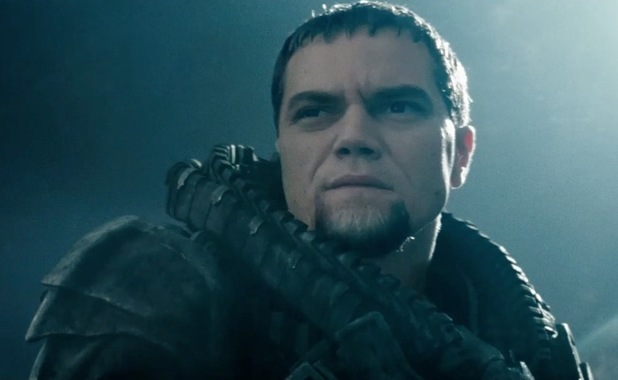
Michael Shannon is reliably intense as General Zod.
You may be somewhat surprised to hear, then, that there were things I liked about the film: the casting was perfect, with Henry Cavill proving a great choice for the eponymous hero, and Michael Shannon a perfect fit for the maniacal and passionate Zod. Moreover, the performances were uniformly good, hampered only by a dreadful script by David Goyer, who, without Christopher Nolan's directorial talent for turning clunky exposition into compelling dialogue, delivers line after line that would embarrass a fourteen year old. I liked that Lois Lane knows who Superman is from the start - it sets up a nice future dynamic between Lois and Clark at The Daily Planet, and elegantly sidesteps the inherent silliness of Clark wearing glasses as a disguise. It's a shame then, that Amy Adams and Cavill have absolutely zero chemistry, hampered by a plot that only gives them a handful of scenes together. Moreover, in those few scenes, they are laden with passionless exposition. Kevin Costner invests his Jonathan Kent with a degree of depth, conflicted by the desire to protect his son from an ignorant world, and the understanding that Clark will one day have to confront his place in the world, but this is undermined by the senseless and frustrating manner of his untimely death.

There are potentially many things to like about Man of Steel, but almost all of them are buried by the film's numerous and inescapable flaws. Lacking depth, subtlety, real tension or even peril, Snyder's re-imagining of Superman is profoundly shallow. But more than that, as I watched Man of Steel, it occured to me that I was watching the death of the superhero film as a major genre. This year we've had Superman, Iron Man, and we are due another Wolverine film (did anyone even want one?). Next year we get to team up with the X-Men again, Spiderman has another crack at amazing us, and in 2015 the Avengers will assemble once more. This is not to mention the host of auxillary features, such as Thor 2 and Captain America 2 that will support these tentpoles. But with production problems on Thor, rumours that Robert Downey Jr. may be recast for Avengers 2, and the endless false-starts for the Justice League movie, I can't help but think that Man of Steel is signalling the superhero cycle's decline: I mean, how many more variations on this story can be written for the big screen? At their best, I love superhero films, and talented writers and directors will always find new stories to tell, and new ways to tell them. But if the superhero genre must go the way of the Western, the Hammer Horror and the Film Noir, I just hope that we can end on something better than this.

Tuesday, 24 July 2012

Bat-Extravaganza Part 2: Mask of The Phantasm

This post must begin with an acknowledgement of the terrible news of the shooting at the cinema in Colorado on Friday. This was a senseless, shocking and unfathomable act of violence, and my thoughts and sincerest condolences go to the victims and their families. Christopher Nolan has responded to the tragedy in a far more sensitive, articulate and poignant way than I could, so I have left a link to his statement here.


After weeks of intense anticipation I saw The Dark Knight Rises on Saturday, and have just returned from seeing it a second time. There are plenty of reviews already available, ranging from the exultant to the disappointed, but on this occasion I'd like to add my own voice to the mix. A nice, full review of The Dark Knight Rises will be forthcoming sometime in the next week, hopefully before the end of the week. Most reviewers have been careful to avoid spoilers but there are a few issues I'd really like to discuss where spoilers can't be avoided, so consider this an early and very major spoiler warning for the next post. If you want to know whether I liked it or whether you should see it, then my initial reaction was that I loved it, and it was a great end to the series, though I had one or two minor issues with it. And yes of course you should see it: it's Batman 3 for Chrissakes!


So, on to the subject of today's post: Batman: Mask of The Phantasm, the all-but-forgotten but quietly brilliant 1993 animated feature. Mask of the Phantasm was released in cinemas following the success of the 1990s TV show, Batman: The Animated Series, which ran for two seasons in its original incarnation from 1992 - 1995. The show itself won many critical plaudits and awards, and is widely regarded as one of the best adaptations of Batman ever produced. The Animated Series is easily one of my favourite TV series, animated or otherwise, combining a beautiful, art deco-influenced aesthetic, mature storylines, a great central performance from Kevin Conroy as Batman, and a terrific supporting cast which includes Mark Hammill as the Joker. Mask of the Phantasm continues the style and mature storylines of the series as a feature, and boy, does it deliver as a full-blown Batman film. The plot revolves around a masked, seemingly invincible spectre that arrives in Gotham and who starts systematically killing mob bosses. Meanwhile, Bruce Wayne is confronted by the reappearance after many years of his lost love, Andrea Beaumont. The action jumps back and forth between Batman's investigation of the mysterious Phantasm as he offs more mobsters, and the flashback scenes in which Bruce's romance with Andrea blossoms. In these scenes, we are presented with a young Wayne, preparing himself to take up the mantle of the crimefighter  that will eventually become Batman. However, he meets Andrea, and in the most emotional scene of the film, questions whether he really wants to fight crime any more. The bare skeleton of the plot of Phantasm seems like pretty standard superhero stuff, particularly with the conflict-from-romantic-entanglement angle, but it's in the execution of these well-worn tropes that Phantasm truly shines, and succeeds in offering emotional maturity and focus that few live-action superhero films have achieved. Audiences familiar with Nolan's superb Batman Begins may find many similar story beats in Phantasm: Bruce's early fights with crooks before he dons the batsuit, for example, and his reasoning behind using a bat as a symbol of fear are prevalent in both Phantasm and Begins: both films are heavily and explicitly influenced by the superlative Frank Miller / David Mazzucchelli Batman: Year One, often regarded as the greatest Batman graphic novel ever written. 

In my view, Mask of the Phantasm is second only to Nolan's Dark Knight Trilogy as the best feature-length Batman film. The Animated Series and Phantasm both took their visual aesthetic cues (as well as their music theme) from Tim Burton's stylised and visually striking Batman and Batman Returns, both of which are very good Batman films in their own rights. But where Burton's films sacrificed emotional depth and narrative coherence (particularly in Returns) for visual splendour and spectacle, Mask of the Phantasm gives us all the stylistic trappings of Batman, and an emotionally compelling and focussed narrative to boot. All the familiar visual cues remain; as well as the suit, the Batcave, and the Burton-era Batmobile, we see Bruce lay the iconic red roses at his parent's grave, complemented by the sky that burns red as a perpetual reminder both of Bruce's anger and of the darkness that he inhabits. Indeed, the depth that the visuals convey is frequently disarming and quite beautiful. For example, the first scene that we see Bruce Wayne (as opposed to Batman), he has slunk off from a party, and his humorous, sociable facade has dropped. In his study he looks up mournfully at a portrait of his parents, tears brimming in his eyes. In a moment of silent reminiscence and grief, Alfred walks in on Bruce as he stands with his back to the door:


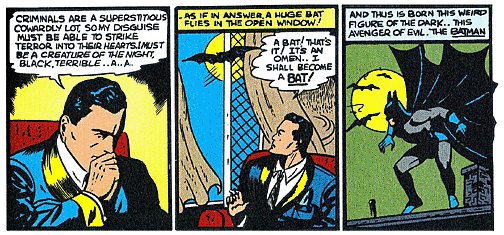
The frame presents us with a remarkable amount of characterisation. Firstly, the camera is up high and away from Bruce, giving us full access to the room. Bruce is a tiny figure, away from the centre of the frame and dwarfed by the room he is in, appearing small and vulnerable. The walls are practically bare, save for the portrait of his parents: a constant reminder of their murder when he was a child. The window frame casts shadows in harsh, chiaroscuro lines that are reminiscent the black and white lines of film noir, and refer both to the shadow of murder and grief that forever hangs on Bruce, as well as to the comic-book origins of the Batman, when Bruce Wayne originally saw a bat at his window, vowing to adopt its image as a symbol of fear against 'cowardly, superstitious' criminals. Alfred stands at the doorway, light flooding in from the party as his shadow is cast on the floor. This sudden influx of warm orangey light contrasts with the cold blue dimness of the rest of the frame, and emphasises not only Bruce's emotional and physical location in the dark, but also that he is there alone, isolated from the external world. Bruce's mentor Alfred remains at the door's threshold, and even the audience's viewpoint is kept away up in the ceiling, reminding us of that separation. Later, in a flashback scene, Bruce proposes to Andrea, and she accepts. Bruce knows that if he is going to have a life with her he will have to give up his career as Batman before it has begun, and he has already chosen to do so. Because the scene is in flashback, we know ultimately how this is going to end for Bruce and Andrea, but in that moment it seems as is if there should be no reason that it won't work out for them. Just as they embrace in the sunset, a mass of bats erupts out of a crack in the rock, swirls around them and flies into the twilight sky reminding us of the inevitability of Bruce's fate and his doomed relationship with Andrea. Not only is this is a visual callback to Batman: Year One  Mask of the Phantasm packed with this kind of rich, visual sensibility, augmented by a very good script that, especially in the flashback scenes, gives Bruce gravitas and depth.


A title page from Batman: Year One

A visual nod to Year One in Mask of the Phantasm


In the scene where Bruce chooses Andrea over a life of fighting crime, he visits his parents' grave to beg forgiveness for the promise he's about to break. Framed by gothic thunder and lightning, and a huge stone gravestone, the most effective part of the scene is where Bruce tries to explain that 'it just doesn't hurt so bad any more'. It's a succinct, emotive line than really humanises Bruce as a young man, beset by a terrible tragedy, who simply wants to get on with his life. For all the nuanced character analysis in Nolan's Bat-series, this scene in Phantasm really encapsulates the ongoing tragedy at the centre of Bruce's life in a way that no other Batman film has achieved. It's all the more sad because we know, at some point, he does become the Batman, and ultimately leave behind any semblance of a normal life. 


Bruce's fate is sealed when Andrea absconds, leaving him her engagement ring. This is what finally convinces Wayne to don the suit and become the Batman, and it's nice to see a new take Batman's origins, complicating the story by having Bruce Wayne's life getting in the way of a promise he made as a child. Back in in the present, the police believe that Batman is behind the mob killings, and before long his old enemy the Joker becomes involved in the fray. Here, the Joker plays as a secondary, though key, villain to the Phantasm, and although you'll probably spot the identity of the Phantasm a mile off, it doesn't diminish the impact when he is finally unmasked. The finale takes place in an abandoned museum of the future, which Joker has made his hideout, which not only makes a great location for some great pyrotechnics, but also provides an ironic setting in which to explore Bruce's inability to escape the past, tortured both by his parents' murders and his lost love. Just like the empty study, Bruce can't leave the decayed, traumatic world of the past to join the living world of the present. It's no surprise then, that he adopts an image of the night, of death, as his symbol. The batsuit, tied as it is to Andrea leaving him, becomes emblematic of Bruce's inertia. What is brilliant about Mask of the Phantasm is that, Nolan's films aside, this really is the most complex presentation of the Bruce Wayne / Batman dual identity we have ever had on screen. Moreover, despite being primarily aimed at a young audience, the emphasis is on nuanced character analysis, not on action. The violence that the film does have is there in service of the story, and while never graphic, is often quite gritty and never feels hamstrung by the film's target family audience. Batman: Mask of the Phantasm really is one of the best Batman films, and offers a unique, compelling and emotive take on the character. With the release of Nolan's final Batman film, it's a great time to find a copy (you can get it on the 'net for a couple of quid) and check out what is in many ways the most faithful, and even definitive cinematic adaptation of Batman.

Next time it's the review you've all been waiting for: The Dark Knight Rises, with plenty of spoilers, so watch this space!